A phalanx of reporters and photographers trailed House Budget Committee Chairman Jodey Arrington, R-Texas, out of the Capitol and across the Capitol grounds last Thursday morning.
The Trump administration planned to ask Congress for an additional $200 billion to cover the cost of the war in Iran. Passing such a plan might be dicey. Especially vaulting the 60 vote barricade in the Senate. But House Speaker Mike Johnson, R-La., and Arrington were already touting a “reconciliation” bill for this year to approve some of the GOP’s domestic policy priorities ahead of the midterms. Reconciliation is inoculated from a Senate filibuster. And other Republicans may be on board with the extra $200 billion if it’s tucked into a reconciliation package which tackles other subjects.
“I think reconciliation is probably going to be the only vehicle that we put anything in because the Democrats aren’t going to support it,” said Arrington, briskly traversing a set of congressional steps near the plaza, bound for Independence Avenue. “I don’t think they’ll support the supplemental for the operating needs for our military while they’re in conflict.”
“The Senate seems kind of suspect of trying to do this,” yours truly followed up as the gaggle of reporters and photographers trekked the Capitol grounds toward the street.
PENTAGON SEEKS AT LEAST $200B FROM CONGRESS FOR IRAN WAR
“The Senate is going to be suspect and slow to be motivated. Which is why the House is the little engine that can. And when the little engine that can, does, then the Senate and other people follow. The House has to lead,” replied Arrington. “We led in the first reconciliation bill. It wouldn’t have been as big or beautiful if we didn’t do our job on the tax cuts. On the spending cuts. On the energy reforms. On the generational welfare reforms.”
The scrum edged closer to Independence Avenue in the shadow of the Longworth House Office Building.
“I’ve got to walk across here. I’m late for a meeting. Y’all can follow me,” instructed Arrington, to the press, pivoting into the crosswalk just as the traffic light changed to green.
THE HITCHHIKER’S GUIDE TO CONGRESS’ OPTIONS ON HAMSTRINGING TRUMP’S WAR POWERS IN IRAN
Three journalists followed the Texas Republican into the street. However, your trusty journalist (and Wayne Elementary School Safety Town participant) remained on the corner.
Two cars and a bus accelerated.
“Wait! Careful! Careful! Careful! Careful! Careful! Careful!” I hollered.
Arrington and the others scurried back to the curb.
“See, you lead. They follow. But they may die,” observed Arrington.
“Are you going to lead the Senate right into a crosswalk with traffic?” I inquired.
Arrington pivoted – both back to the curb and to policy – as cars and scooters whizzed by.
“I think my counterpart, (Senate Budget Committee Chairman) Lindsey Graham, R-S.C., understands that the only train leaving the station for the bigger vision for our military will be a reconciliation bill,” said Arrington.
It’s unclear whether Arrington switching to railroads and locomotives was the best rhetorical shift considering the close call on the street. But Arrington may be right. It will be challenging to pass anything substantial for the rest of this Congress. And perhaps zippering the $200 billion for the war into a reconciliation measure with other policy sweeteners could be the most palatable option to Republicans.
“We have to continue to look at offsetting,” said Rep. Tony Wied, R-Wis.
“I think it should be offset,” said Rep. Tim Burchett, R-Tenn.
“It is expensive,” conceded House Veterans’ Affairs Committee Chairman Mike Bost, R-Ill., about the spending request.
REPORTER’S NOTEBOOK: GOP PUSHES ELECTION SECURITY BILL DESPITE SLIM ODDS, AS TRUMP PRESSURE LOOMS
But offsets come from cuts. And lawmakers don’t like to slash programs important to their jurisdiction, state or district.
“A lot of the VA stuff, that’s like the third rail in politics. You don’t cut that,” said Bost.
What could contribute to an offset? Arrington suggested Republicans should turn to the time-tested Washington law firm of “Waste, Fraud and Abuse” to mitigate the cost of the war.
Rep. Alexandria Ocasio-Cortez, D-N.Y., replied “no” when asked about the supplemental spending request.
“It is skyrocketing prices of everything across the board, and Congress didn’t even approve. And so to have the audacity to come to Congress to fund a war that we have not even voted for it – not only is it illegal, it is insulting,” said Ocasio-Cortez.
I asked about whether it was dangerous for lawmakers to leave American troops in the lurch when they’re exposed to hostilities abroad.
“They should have thought about that before they entered a conflict without Congress,” said Ocasio-Cortez. “They told everybody that it was just a quick in and out strike and now they have found themselves in a disaster. And we cannot enable this kind of reckless and illegal behavior.”
Ocasio-Cortez is hinting at the ultimate Congressional authority: power of the purse. Lawmakers are charged with approving 12 spending bills to run the government each year. A supplemental spending package – say for war, terrorism, recovery from natural disasters or economic stimulus – is a “13th” spending bill. It’s plopped on top of the customary 12. Lawmakers could really hamstring the war in Iran if they decide to pull the funding.
The White House scored about $1 trillion from Congress in Fiscal Year 2026 for the military. President Trump’s request for the Pentagon for Fiscal Year 2027 – still unapproved – is $1.5 trillion. That’s a 50 percent increase. That particular ask of Congress came before the $200 billion ask for the war in Iran.
DEMS’ POTENTIAL 2028 HOPEFULS COME OUT AGAINST US STRIKES ON IRAN
The president has sent mixed signals as to whether the war is “ending.” A reporter asked President Trump if he still needed the $200 billion.
“It’s always nice to have. It’s a very inflamed world. And the Democrats inflame it,” replied the president.
But it’s generally believed that the Pentagon needs the money because it’s burned through so many munitions in Iran.
So this supplemental spending request must navigate the Congressional traffic.
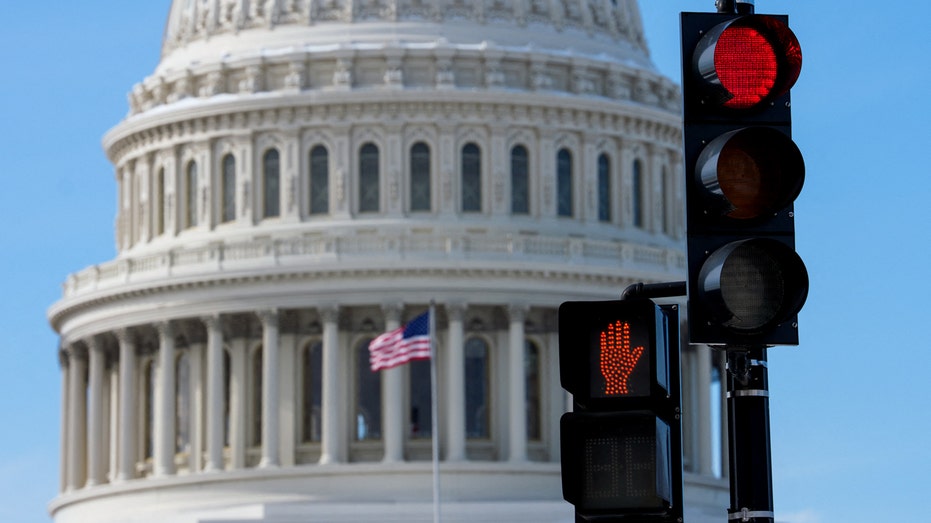
Regular traffic and pedestrian signals switch on a regular basis. But not necessarily political signals. There’s no way right now for lawmakers to greenlight an extra $200 billion for the war. That’s because the “don’t walk” light is flashing.
The question now is how long it takes for the light to change. Or, if it will ever cycle through. Otherwise, Congressional leaders could put the bill on the floor – and get mowed down by a political bus.